


The aerospace industry is experiencing one of the most significant technological transformations in its history. From next-generation commercial aircraft and military platforms to helicopters and unmanned aerial vehicles (UAVs), avionics systems are becoming more intelligent, interconnected, and software-defined than ever before.
This evolution is dramatically changing how aerospace manufacturers approach testing.
Modern Avionics Test Equipment must validate thousands of electrical connections, multiple communication protocols, high-speed digital interfaces, RF signals, fiber optics, and power distribution—all within a single automated test environment.
As a result, traditional testing architectures are reaching their limits.
This article explores the biggest challenges facing today's Aircraft Test Systems and explains why modular Mass Interconnect Systems are becoming the preferred solution for next-generation aerospace testing.
The Growing Complexity of Modern Avionics
Today's aircraft contain significantly more electronic systems than previous generations.
A modern commercial aircraft may include:
Flight Control Computers
Flight Management Systems (FMS)
Navigation Systems
Radar Systems
Communication Modules
Electronic Warfare Systems
Power Distribution Units
Health Monitoring Systems
Satellite Communication Equipment
Aircraft Sensor Networks
Each subsystem must undergo extensive functional verification before installation and final delivery.
Unlike conventional electronics manufacturing, aerospace testing must comply with extremely high standards for reliability, repeatability, and traceability.
This increasing complexity places enormous pressure on avionics test engineers to build more flexible, scalable, and maintainable test platforms.
Challenge 1: High-Density Signal Integration
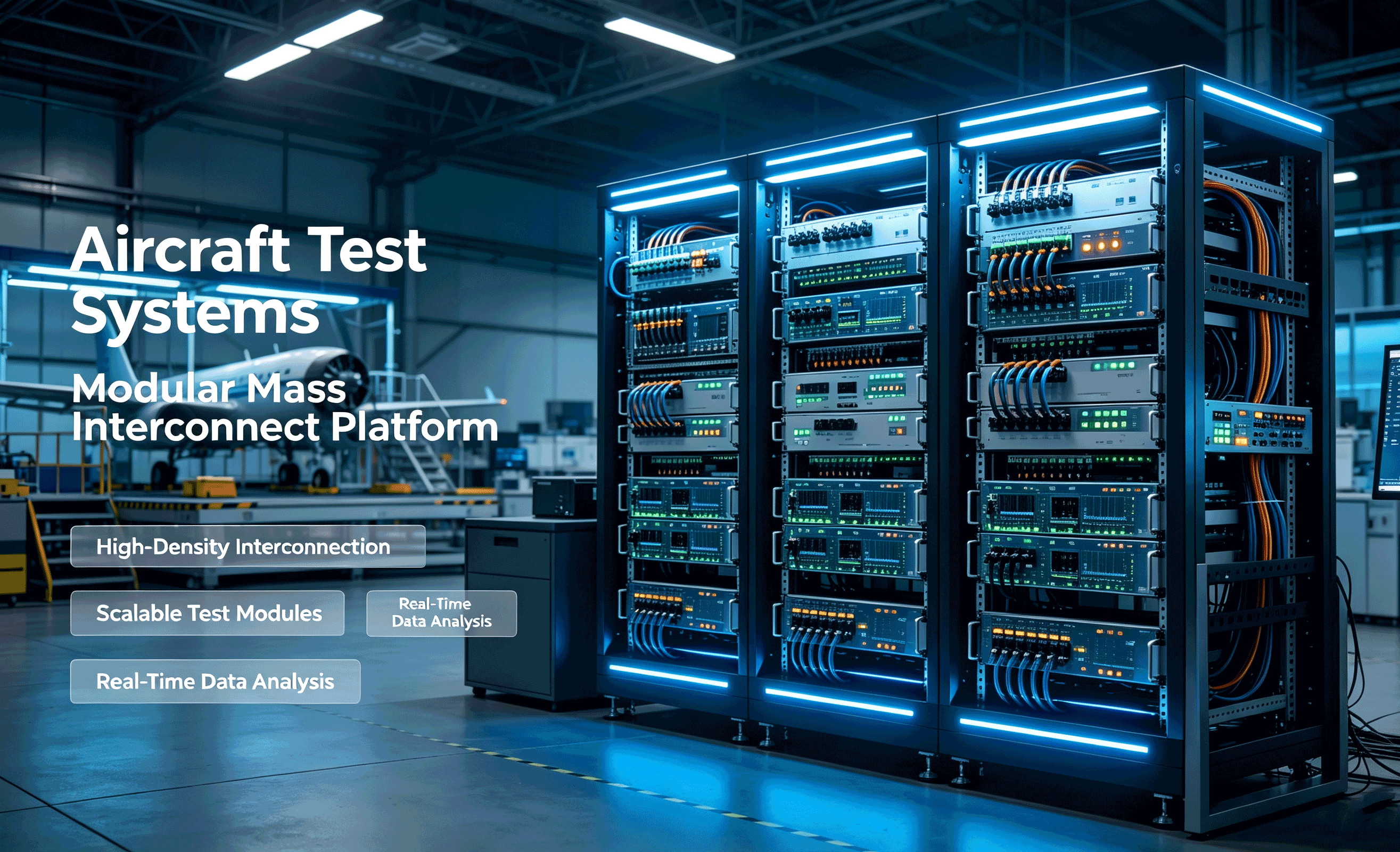
One of the biggest challenges in modern Avionics Test Equipment is managing thousands of electrical signals within a limited physical space.
A single avionics rack may include:
Analog Signals
Digital I/O
CAN Bus
ARINC 429
MIL-STD-1553
Ethernet
USB
Fiber Optics
RF Interfaces
High Current Power
Traditional point-to-point wiring quickly becomes difficult to manage as interface density increases.
Complex cable assemblies also make maintenance more time-consuming and increase the risk of wiring errors.
Modular Mass Interconnect Systems simplify this challenge by consolidating multiple signal types into one centralized docking interface, significantly improving organization and reducing system complexity.
Challenge 2: Multiple Communication Standards in One Test Platform
Aircraft electronics rarely rely on a single communication protocol.
A modern Aircraft Test System often needs to support multiple interface standards simultaneously, including:
ARINC 429
MIL-STD-1553
Ethernet
Serial Communication
Fiber Optic Networks
RF Signals
High-Speed Digital Interfaces
As new aircraft platforms continue adopting faster communication technologies, test systems must remain adaptable without requiring complete redesigns.
A modular Mass Interconnect architecture allows engineers to replace or add interface modules without rebuilding the entire test station.
This flexibility significantly reduces engineering effort while extending the service life of the test platform.
Challenge 3: Aircraft Wire Harness Testing Becomes More Critical
Modern aircraft contain hundreds of wiring harness assemblies connecting thousands of electrical components.
These harnesses serve as the nervous system of the aircraft.
Every connection must be verified before final assembly.
Aircraft Wire Harness Testing presents several challenges:
Thousands of continuity checks
High pin-count connectors
Complex routing
Repeatability requirements
Frequent fixture maintenance
Conventional manual connections often suffer from wear after repeated insertion cycles.
Replacing an entire fixture is both expensive and time-consuming.
A modular interconnect platform enables worn interface modules to be replaced individually, dramatically reducing maintenance costs and minimizing production downtime.
Challenge 4: PXI Test Systems Require Smarter Connectivity
PXI has become one of the most widely adopted architectures for automated aerospace testing.
A typical PXI Test System provides outstanding flexibility by integrating measurement instruments, switching modules, power supplies, and data acquisition devices within a unified platform.
However, the overall performance of a PXI-based test station depends not only on instrumentation but also on reliable signal transmission between the PXI chassis and the Device Under Test (DUT).
This is where a high-quality Mass Interconnect solution becomes essential.
An optimized interconnect platform improves:
Signal integrity
High-speed data transmission
System organization
Maintenance efficiency
Future scalability
By combining PXI instrumentation with modular interface technology, aerospace manufacturers can build test systems that are both high-performance and easy to maintain.
Challenge 5: Faster Product Development Requires More Flexible Test Platforms
Aircraft development cycles continue to shorten.
Manufacturers now release updated avionics hardware and software much more frequently than in the past.
As products evolve, test systems must evolve with them.
Unfortunately, many traditional fixtures are designed for only one product generation.
Every engineering change may require extensive rewiring or fixture reconstruction.
A modular Mass Interconnect System eliminates this limitation.
Instead of redesigning the complete interface, engineers simply replace or reconfigure individual modules to accommodate new signal requirements.
This modular approach significantly reduces engineering time while improving long-term return on investment.
Why Modular Mass Interconnect Systems Are Becoming the Industry Standard
The role of a modern Mass Interconnect platform extends far beyond connector management.
It has become the backbone of today's automated aerospace test infrastructure.
A well-designed Mass Interconnect solution provides:
High-density interface integration
Mixed signal capability
RF and Fiber support
High-current power modules
Pneumatic integration
Rapid module replacement
Long service life
Simplified maintenance
Improved operator efficiency
These advantages explain why modular architectures are increasingly adopted in avionics production, aircraft maintenance, defense electronics, and aerospace research laboratories.
TFC V50 Series: Designed for Next-Generation Aerospace Testing
At TFC, we understand the challenges facing today's aerospace testing engineers.
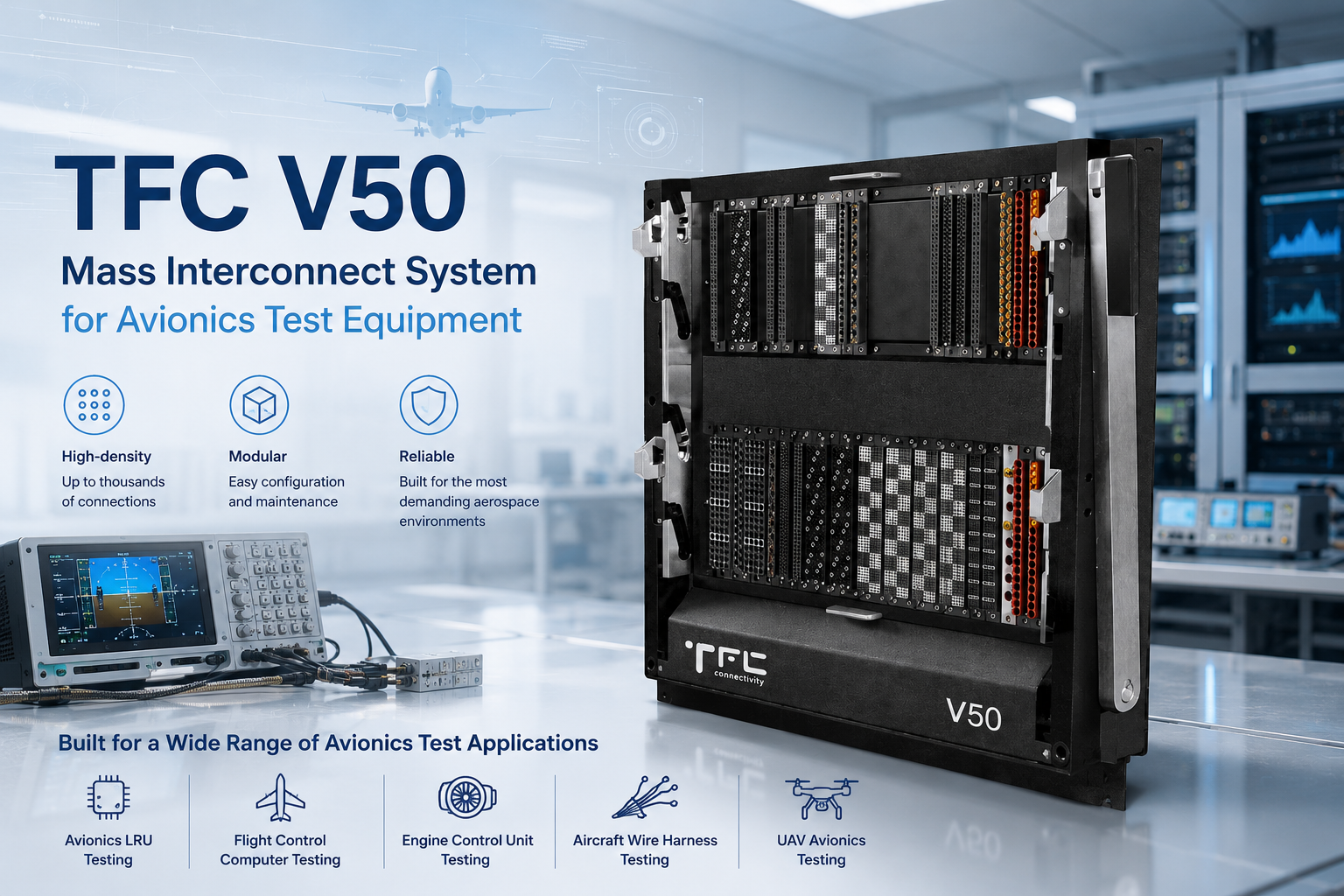
The V50 Series Mass Interconnect System is designed to support complex automated test environments where reliability, flexibility, and maintainability are critical.
Key capabilities include:
High-density modular architecture
Mixed signal integration
RF interface modules
Fiber optic connectivity
High-current power modules
PXI cable integration
Custom Interface Test Adapter (ITA) solutions
Long insertion cycle durability
Scalable platform for future expansion
Whether testing flight control computers, avionics LRUs, aircraft wire harnesses, engine control units, or UAV electronics, the V50 Series provides a robust foundation for modern automated testing.
Typical Aerospace Applications
The TFC V50 Series is widely suited for a variety of aerospace test environments, including:
| Application | Recommended Solution |
| Flight Control Computer Testing | V50 Mass Interconnect + ITA |
| Avionics LRU Functional Testing | Modular Mixed Signal Interface |
| Aircraft Wire Harness Testing | High-Density Interface Modules |
| Aircraft Engine Test Bench | Power + Signal + RF Modules |
| UAV Production Test | PXI Test System + V50 Platform |
| Satellite Communication Testing | Fiber Optic + RF Modules |
| Ground Support Equipment (GSE) | Customized Interconnect Solutions |
Looking Ahead
The future of aerospace testing is not simply about adding more measurement instruments.
It is about building intelligent, modular, and scalable test architectures capable of supporting increasingly sophisticated aircraft electronics.
As avionics systems continue to evolve, aerospace manufacturers will require test platforms that offer greater flexibility, higher reliability, and lower lifecycle costs.
Modular Mass Interconnect Systems are no longer optional—they have become a strategic component of modern Aircraft Test Systems.
At TFC, we are committed to helping aerospace manufacturers, ATE integrators, and test engineers build smarter testing solutions for the next generation of aviation.
Ready to Upgrade Your Aerospace Test Platform?
Whether you are designing a new PXI Test System, upgrading existing Avionics Test Equipment, or developing a high-density Aircraft Wire Harness Testing solution, our engineering team is ready to help.
Contact TFC today to discuss your application requirements and discover how the V50 Series Mass Interconnect System can improve the efficiency, reliability, and scalability of your aerospace testing projects.
