

How to Build an ATE Test System
A Practical Guide for Test Engineers
What is an ATE Test System?
An ATE Test System (Automated Test Equipment System) is a platform that automatically performs electrical, functional, and performance testing on a Device Under Test (DUT).
ATE systems are widely used in:
Semiconductor Testing
Automotive Electronics Testing
Aerospace Testing
Medical Device Testing
Industrial Automation
Battery & BMS Testing
The primary goal is:
✅ Improve test coverage
✅ Reduce manual operations
✅ Increase production throughput
✅ Ensure product quality
Typical ATE Architecture

Step 1: Define Test Requirements
Before selecting hardware, define:
DUT Type
Examples: ECU / BMS / PCB Assembly / Avionics Unit / Semiconductor Device
Signal Types
Determine: Digital / Analog / RF / Fiber / Power / Pneumatic
Example: 128 Digital Channels or 32 Analog Channels or 8 RF Ports or 4 Fiber Channels or 12 Power Lines
This determines the required Mass Interconnect System.
Step 2: Select Test Instruments
Most modern ATE systems use PXI.
Popular platforms:
Vendor | Platform |
| National Instruments | PXI |
| Pickering | PXI |
| Keysight | PXI |
| Marvin Test | PXI |
| Chroma | PXI |
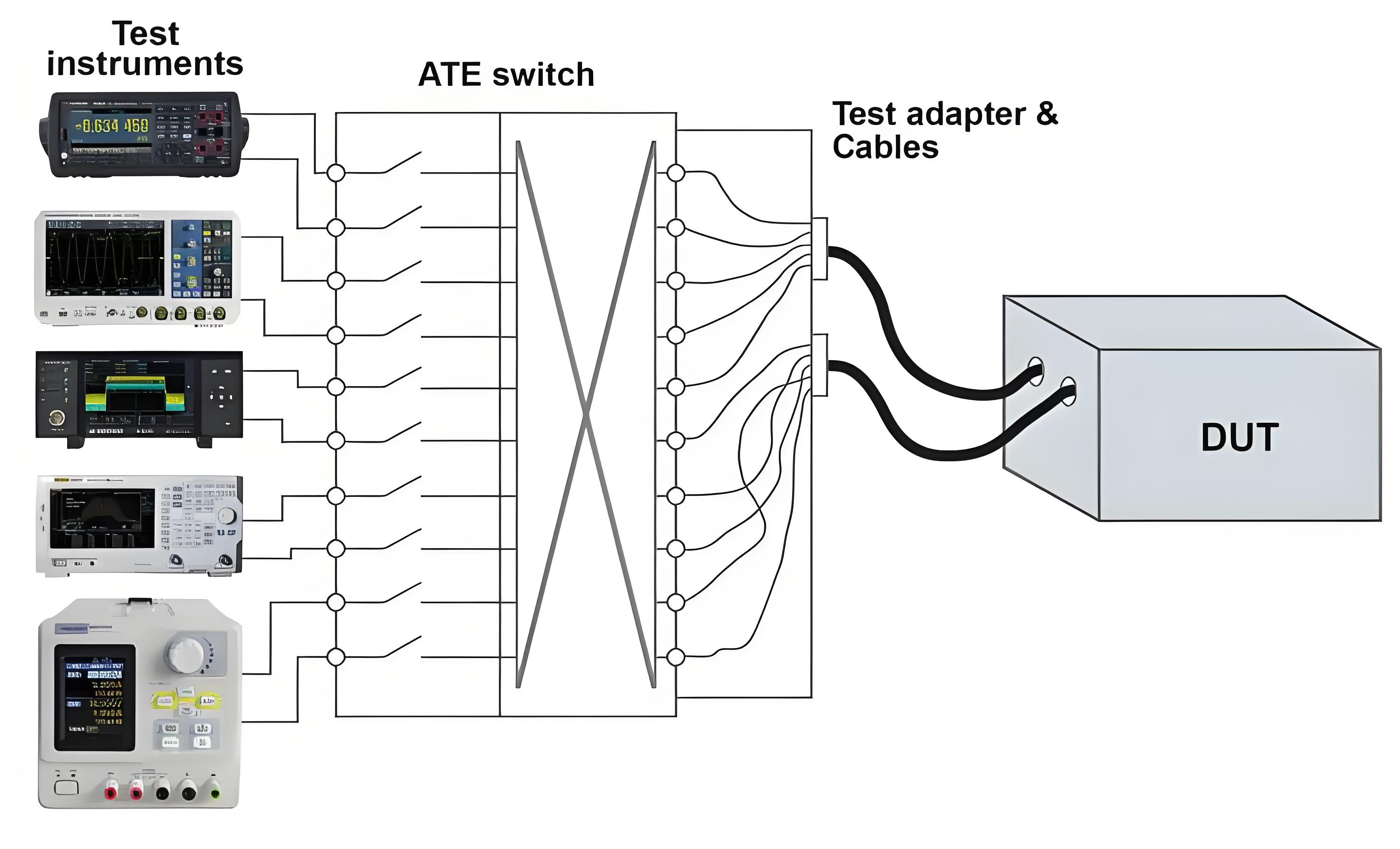
Common modules:
DMM | Voltage measurement |
Switching | Signal routing |
Digital I/O | Logic verification |
SMU | Source Measure Unit |
Oscilloscope | Waveform analysis |
RF Analyzer | RF validation |
Step 3: Design the Mass Interconnect System
This is where many engineers make mistakes. Without a proper Mass Interconnect System:
❌ Cable chaos ❌ Difficult maintenance ❌ Long changeover time ❌ Signal integrity issues
Recommended typical solution:
Small System | TFC V2 |
Medium System | TFC V6 |
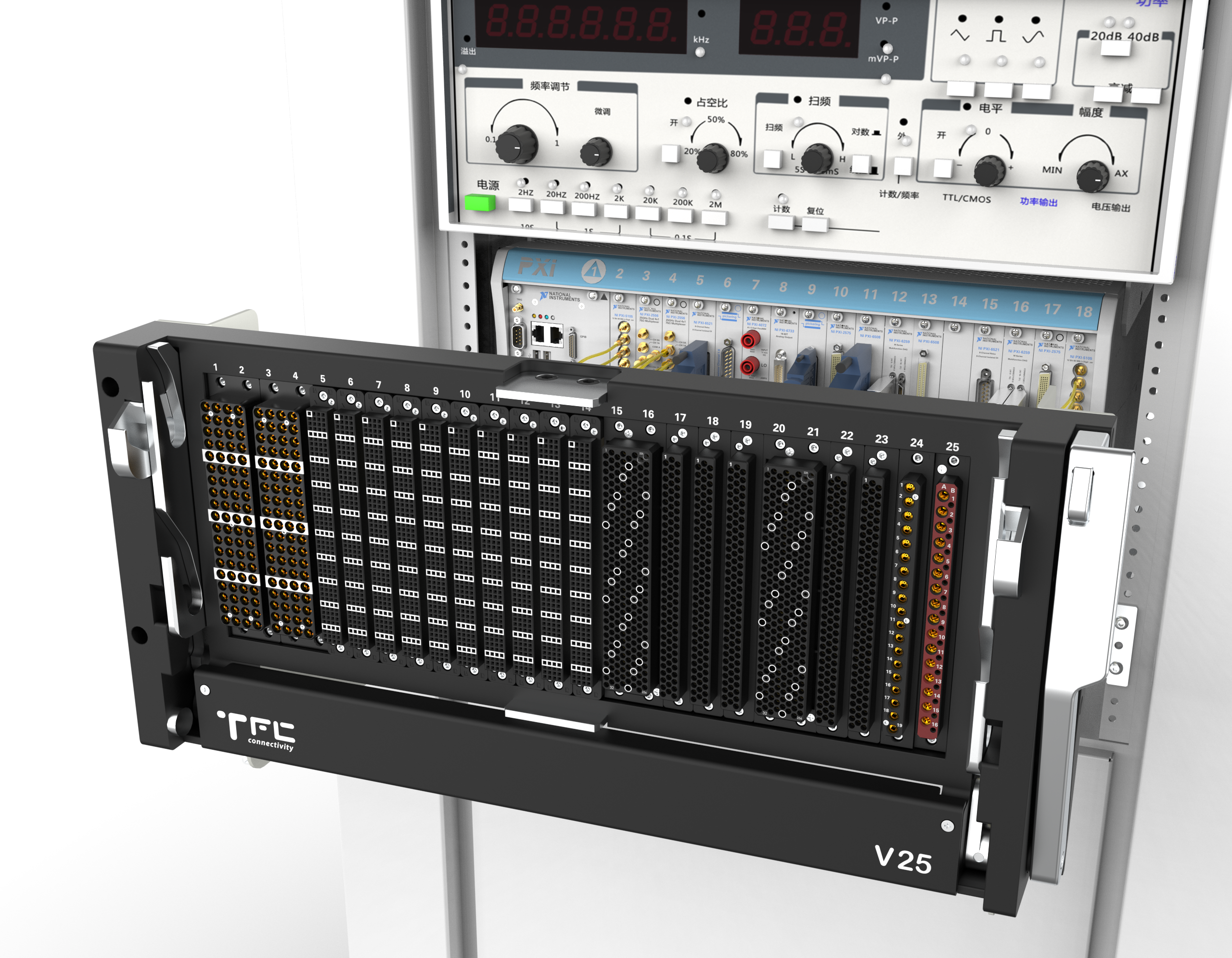
Standard ATE | TFC V18 / V25 |
High Channel Count | TFC V50 |
Step 4: Design the ITA
The ITA (Interface Test Adapter) connects the test system to the DUT.
Typical ITA contains:
Connector Interfaces
Cable Harnesses
Breakout Boards
Signal Conditioning
Benefits:
Fast changeover
Easy maintenance
Product-specific fixture
Step 5: Integrate Multi-Signal Modules
Modern DUTs require more than simple signal connections.
A good ATE Test System should support:
Signal Modules / RF Modules / Fiber Modules / Power Modules / Pneumatic Modules
TFC V18、V25 and V50 allow all signal types to be integrated into one receiver.
Step 6: Develop Test Software
Most systems use:
NI TestStand | Test sequencing |
LabVIEW | Control and measurement |
Python | Custom automation |
C# | Manufacturing execution systems |
Example workflow:
Initialize Instruments
Load Test Sequence
Switch Signals
Acquire Data
Analyze Results
Generate Report
Step 7: Verify Signal Integrity
Critical for:
High-speed digital
RF
Aerospace
Semiconductor
Key checks:
Contact Resistance / Crosstalk / Return Loss / Insertion Loss / Isolation
This is why the Mass Interconnect System is a critical component.
Step 8: Plan for Future Expansion
Many systems fail because they are designed only for today's requirements.
Good ATE architecture should support:
Additional channels
New DUT variants
RF upgrades
Fiber upgrades
New test programs
Modular platforms like TFC V18、V25、V50 all allow future expansion without redesigning the entire test system.
Recommended ATE Configurations
Automotive ECU Testing | Battery BMS Testing | Semiconductor Test | Aerospace Avionics Test |
| PXI Chassis | PXI Chassis | ATE Rack | PXI Platform |
TFC V18 | TFC M12 | TFC V50 | TFC V25/V50 |
| ECU ITA | Battery Adapter | Custom ITA | ARINC Adapter |
| ECU DUT | BMS DUT | Test Socket | Avionics LRU |
Why the Mass Interconnect System Matters
In most ATE projects:
Instruments account for 50% of the budget
Software accounts for 30%
Interconnect accounts for only 20%
However, more than 70% of maintenance issues occur at the interconnect layer.
Choosing a scalable Mass Interconnect System with flexible Test Adapter Interface design can significantly reduce downtime, maintenance costs, and future upgrade complexity.
